# Submanifold Sparse Convolutional Networks
This is the PyTorch library for training Submanifold Sparse Convolutional Networks.
## Spatial sparsity
This library brings [Spatially-sparse convolutional networks](https://github.com/btgraham/SparseConvNet) to PyTorch. Moreover, it introduces **Submanifold Sparse Convolutions**, that can be used to build computationally efficient sparse VGG/ResNet/DenseNet-style networks.
With regular 3x3 convolutions, the set of active (non-zero) sites grows rapidly:

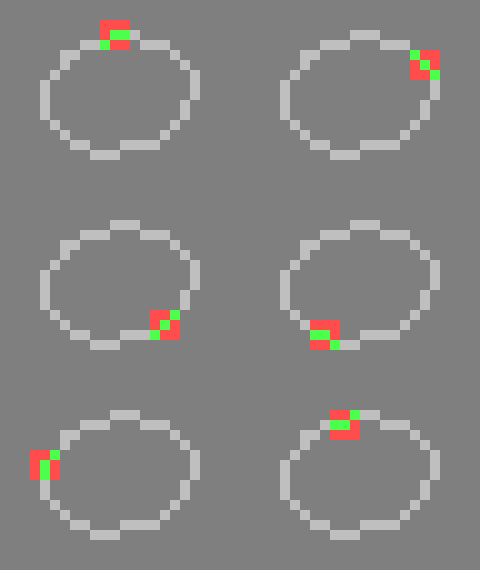
With **Submanifold Sparse Convolutions**, the set of active sites is unchanged. Active sites look at their active neighbors (green); non-active sites (red) have no computational overhead:
Stacking Submanifold Sparse Convolutions to build VGG and ResNet type ConvNets, information can flow along lines or surfaces of active points.
Disconnected components don't communicate at first, although they will merge due to the effect of strided operations, either pooling or convolutions. Additionally, adding ConvolutionWithStride2-SubmanifoldConvolution-DeconvolutionWithStride2 paths to the network allows disjoint active sites to communicate; see the 'VGG+' networks in the paper.


From left: **(i)** an active point is highlighted; a convolution with stride 2 sees the green active sites **(ii)** and produces output **(iii)**, 'children' of hightlighted active point from (i) are highlighted; a submanifold sparse convolution sees the green active sites **(iv)** and produces output **(v)**; a deconvolution operation sees the green active sites **(vi)** and produces output **(vii)**.
## Dimensionality and 'submanifolds'
SparseConvNet supports input with different numbers of spatial/temporal dimensions.
Higher dimensional input is more likely to be sparse because of the 'curse of dimensionality'.
Dimension|Name in 'torch.nn'|Use cases
:--:|:--:|:--:
1|Conv1d| Text, audio
2|Conv2d|Lines in 2D space, e.g. handwriting
3|Conv3d|Lines and surfaces in 3D space or (2+1)D space-time
4| - |Lines, etc, in (3+1)D space-time
We use the term 'submanifold' to refer to input data that is sparse because it has a lower effective dimension than the space in which it lives, for example a one-dimensional curve in 2+ dimensional space, or a two-dimensional surface in 3+ dimensional space.
In theory, the library supports up to 10 dimensions. In practice, ConvNets with size-3 SVC convolutions in dimension 5+ may be impractical as the number of parameters per convolution is growing exponentially. Possible solutions include factorizing the convolutions (e.g. 3x1x1x..., 1x3x1x..., etc), or switching to a hyper-tetrahedral lattice (see [Sparse 3D convolutional neural networks](http://arxiv.org/abs/1505.02890)).
## Hello World
SparseConvNets can be built either by [defining a function that inherits from torch.nn.Module](examples/Assamese_handwriting/VGGplus.py) or by stacking modules in a [sparseconvnet.Sequential](PyTorch/sparseconvnet/sequential.py):
```
import torch
import sparseconvnet as scn
# Use the GPU if there is one, otherwise CPU
device = 'cuda:0' if torch.cuda.is_available() else 'cpu'
model = scn.Sequential().add(
scn.SparseVggNet(2, 1,
[['C', 8], ['C', 8], ['MP', 3, 2],
['C', 16], ['C', 16], ['MP', 3, 2],
['C', 24], ['C', 24], ['MP', 3, 2]])
).add(
scn.SubmanifoldConvolution(2, 24, 32, 3, False)
).add(
scn.BatchNormReLU(32)
).add(
scn.SparseToDense(2, 32)
).to(device)
# output will be 10x10
inputSpatialSize = model.input_spatial_size(torch.LongTensor([10, 10]))
input_layer = scn.InputLayer(2, inputSpatialSize)
msgs = [[" X X XXX X X XX X X XX XXX X XXX ",
" X X X X X X X X X X X X X X X X ",
" XXXXX XX X X X X X X X X X XXX X X X ",
" X X X X X X X X X X X X X X X X X X ",
" X X XXX XXX XXX XX X X XX X X XXX XXX "],
[" XXX XXXXX x x x xxxxx xxx ",
" X X X XXX X x x x x x x x ",
" XXX X x xxxx x xxxx xxx ",
" X X XXX X x x x x x ",
" X X XXXX x x x x xxxx x ",]]
# Create Nx3 and Nx1 vectors to encode the messages above:
locations = []
features = []
for batchIdx, msg in enumerate(msgs):
for y, line in enumerate(msg):
for x, c in enumerate(line):
if c == 'X':
locations.append([y, x, batchIdx])
features.append([1])
locations = torch.LongTensor(locations)
features = torch.FloatTensor(features).to(device)
input = input_layer([locations,features])
print('Input SparseConvNetTensor:', input)
output = model(input)
# Output is 2x32x10x10: our minibatch has 2 samples, the network has 32 output
# feature planes, and 10x10 is the spatial size of the output.
print('Output SparseConvNetTensor:', output)
```
## Examples
Examples in the examples folder include
* [Assamese handwriting recognition](https://archive.ics.uci.edu/ml/datasets/Online+Handwritten+Assamese+Characters+Dataset#)
* [Chinese handwriting for recognition](http://www.nlpr.ia.ac.cn/databases/handwriting/Online_database.html)
* [3D Segmentation](https://shapenet.cs.stanford.edu/iccv17/) using ShapeNet Core-55
* [ScanNet](http://www.scan-net.org/) 3D Semantic label benchmark
For example:
```
cd examples/Assamese_handwriting
python VGGplus.py
```
## Setup
Tested with PyTorch 1.3, CUDA 10.0, and Python 3.3 with [Conda](https://www.anaconda.com/).
```
conda install pytorch torchvision cudatoolkit=10.0 -c pytorch # See https://pytorch.org/get-started/locally/
git clone git@github.com:facebookresearch/SparseConvNet.git
cd SparseConvNet/
bash develop.sh
```
To run the examples you may also need to install unrar:
```
apt-get install unrar
```
## License
SparseConvNet is BSD licensed, as found in the LICENSE file. [Terms of use](https://opensource.facebook.com/legal/terms). [Privacy](https://opensource.facebook.com/legal/privacy)
## Links
1. [ICDAR 2013 Chinese Handwriting Recognition Competition 2013](https://web.archive.org/web/20160418143451/http://www.nlpr.ia.ac.cn/events/CHRcompetition2013/competition/Home.html) First place in task 3, with test error of 2.61%. Human performance on the test set was 4.81%. [Report](https://web.archive.org/web/20160910012723/http://www.nlpr.ia.ac.cn/events/CHRcompetition2013/competition/ICDAR%202013%20CHR%20competition.pdf)
2. [Spatially-sparse convolutional neural networks, 2014](http://arxiv.org/abs/1409.6070) SparseConvNets for Chinese handwriting recognition
3. [Fractional max-pooling, 2014](http://arxiv.org/abs/1412.6071) A SparseConvNet with fractional max-pooling achieves an error rate of 3.47% for CIFAR-10.
4. [Sparse 3D convolutional neural networks, BMVC 2015](http://arxiv.org/abs/1505.02890) SparseConvNets for 3D object recognition and (2+1)D video action recognition.
5. [Kaggle plankton recognition competition, 2015](https://www.kaggle.com/c/datasciencebowl) Third place. The competition solution is being adapted for research purposes in [EcoTaxa](http://ecotaxa.obs-vlfr.fr/).
6. [Kaggle Diabetic Retinopathy Detection, 2015](https://www.kaggle.com/c/diabetic-retinopathy-detection/) First place in the Kaggle Diabetic Retinopathy Detection competition.
7. [Submanifold Sparse Convolutional Networks, 2017](https://arxiv.org/abs/1706.01307) Introduces deep 'submanifold' SparseConvNets.
8. [Workshop on Learning to See from 3D Data, 2017](https://shapenet.cs.stanford.edu/iccv17workshop/) First place in the [semantic segmentation](https://shapenet.cs.stanford.edu/iccv17/) competition. [Report](https://arxiv.org/pdf/1710.06104)
9. [3D Semantic Segmentation with Submanifold Sparse Convolutional Networks, 2017](https://arxiv.org/abs/1711.10275) Semantic segmentation for the ShapeNet Core55 and NYU-DepthV2 datasets, CVPR 2018
10. [ScanNet 3D semantic label benchmark 2018](http://kaldir.vc.in.tum.de/scannet_benchmark/semantic_label_3d) 0.726 average IOU.
11. [MinkowskiEngine](https://github.com/StanfordVL/MinkowskiEngine) is an alternative implementation of SparseConvNet.
12. [OccuSeg](https://arxiv.org/abs/2003.06537) object detection using SparseConvNets
## Citations
If you find this code useful in your research then please cite:
**[3D Semantic Segmentation with Submanifold Sparse Convolutional Networks, CVPR 2018](https://arxiv.org/abs/1711.10275)**
[Benjamin Graham](https://research.fb.com/people/graham-benjamin/),
[Martin Engelcke](http://ori.ox.ac.uk/mrg_people/martin-engelcke/),
[Laurens van der Maaten](https://lvdmaaten.github.io/),
```
@article{3DSemanticSegmentationWithSubmanifoldSparseConvNet,
title={3D Semantic Segmentation with Submanifold Sparse Convolutional Networks},
author={Graham, Benjamin and Engelcke, Martin and van der Maaten, Laurens},
journal={CVPR},
year={2018}
}
```
and/or
**[Submanifold Sparse Convolutional Networks, https://arxiv.org/abs/1706.01307](https://arxiv.org/abs/1706.01307)**
[Benjamin Graham](https://research.fb.com/people/graham-benjamin/),
[Laurens van der Maaten](https://lvdmaaten.github.io/),
```
@article{SubmanifoldSparseConvNet,
title={Submanifold Sparse Convolutional Networks},
author={Graham, Benjamin and van der Maaten, Laurens},
journal={arXiv preprint arXiv:1706.01307},
year={2017}
}
```